
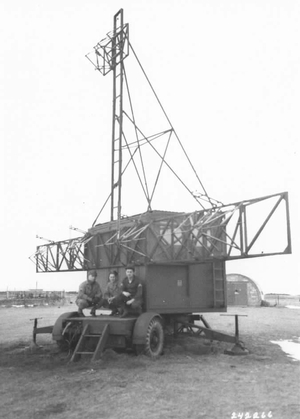
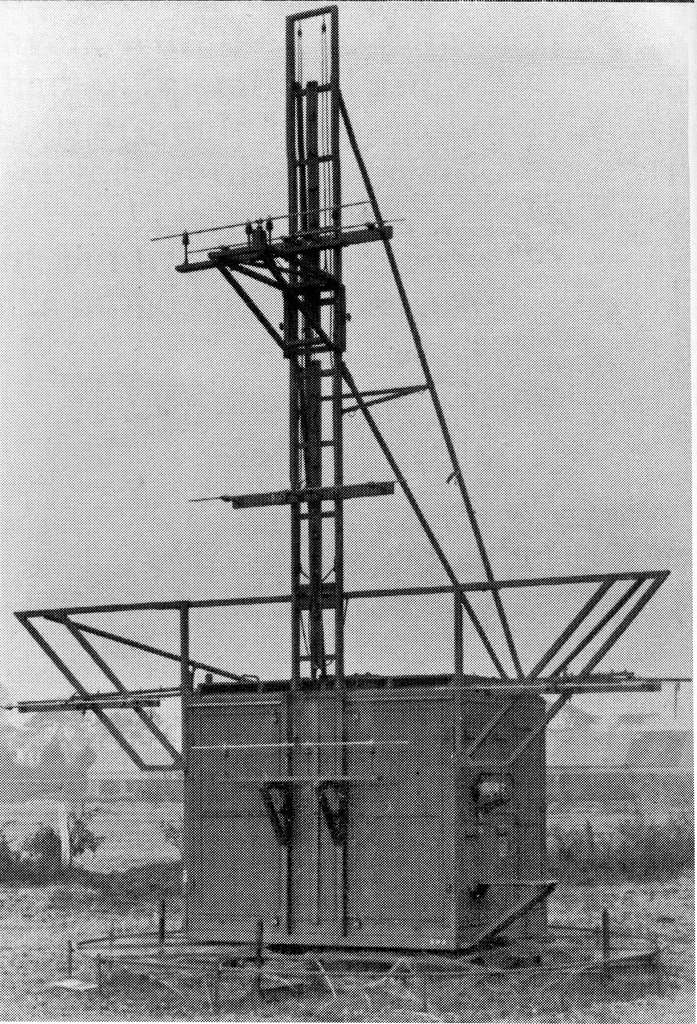
The Radar GL No.2 (Gun Laying Radar No. 1 Mk2) still had its transmitter and receiver mounted in separate cabins although the transmitter was now rotatable as well. A single dipole aerial on a mast provided floodlit coverage. When a target was detected, the beam was concentrated to about 30 degrees by switching in an array of 4 half-wave dipoles. The cabin was then rotated to bring it in to line with the bearing found by the Receiver. To allow the bearing to be constantly followed, a third dipole was added to the 2 horizontal dipoles used to determine the bearing. This produced a beam which swung from side to side at a rate of 20 Hz giving the effect of 2 beams overlapping.
These two beams were superimposed on a CRT screen and coloured filters made the right hand beam appear red and the left appear green. When the two signals were equal the tip appeared white indicating the true bearing. A red tip showed the system was pointing to the left of the target and a green tip to the right so the cabin was rotated until a white tip appeared. The bearing produced was accurate to about 1 degree. Later the beams were shown side by side on the CRT making it easier for the operators.
Elevation was measured using the same system as the GL No.1/EF. To get an accurate reading the wire mesh mat was still needed, but because of the time it took to lay it was mostly used on static HAA positions only. The Receiver cabin had 3 CRT displays for bearing, range and elevation. The roof of the Receiver cabin mounted a Yagi aerial for IFF (Identification Friend or Foe).
By the end of 1942 the Sperry and Vickers predictors had been modified to accept bearing, range and elevation data direct from the radar. It was now possible to engage unseen targets with predicted fire, dependant on the operators skill and the accuracy of the radar. By 1943 it was possible to detect targets at 56 Km (50,000 yards), follow them from 27 Km (30,000 yards) and from 13,000m (14,00 yards) control the fire on them.
| Frequency | 54.5 to 85.7 MHz |
| PRF | 1 to 2.5 kHz |
| Pulsewidth | 1 to 1.2 µs |
| Power | 150 kW peak |
Page last updated on 11/6/26.