
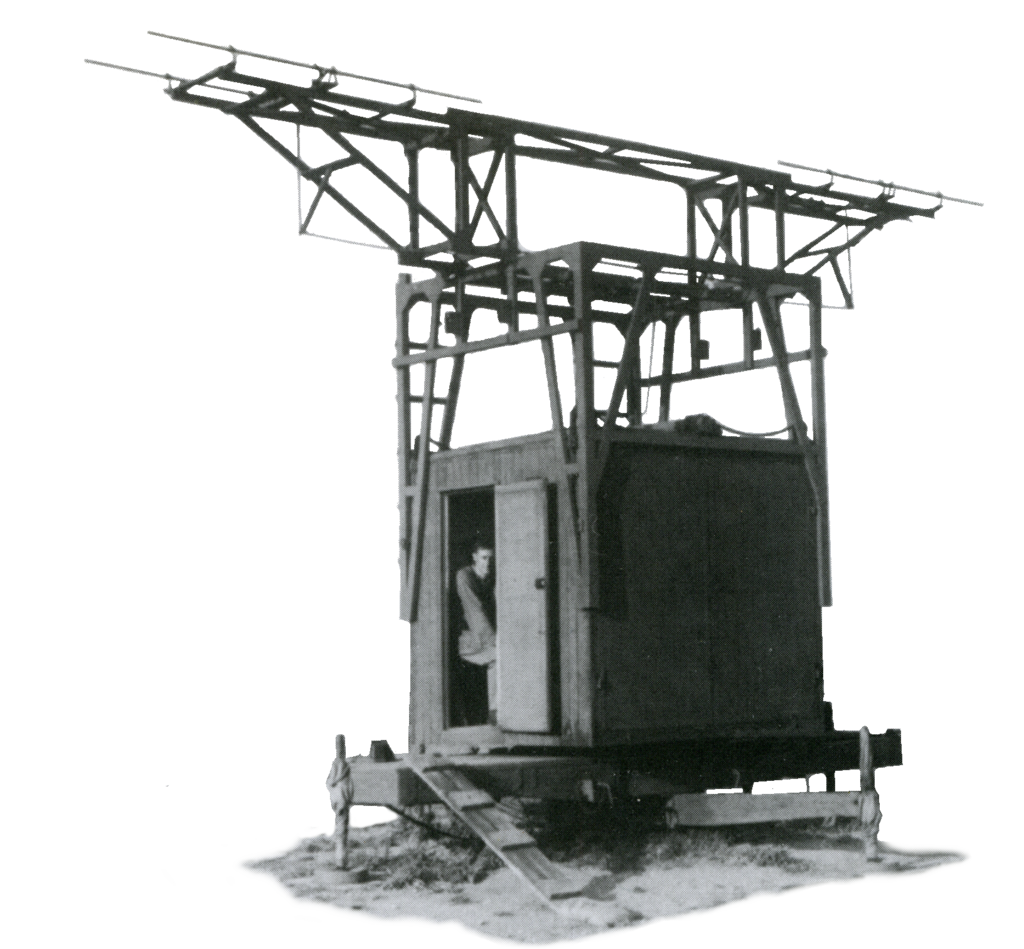
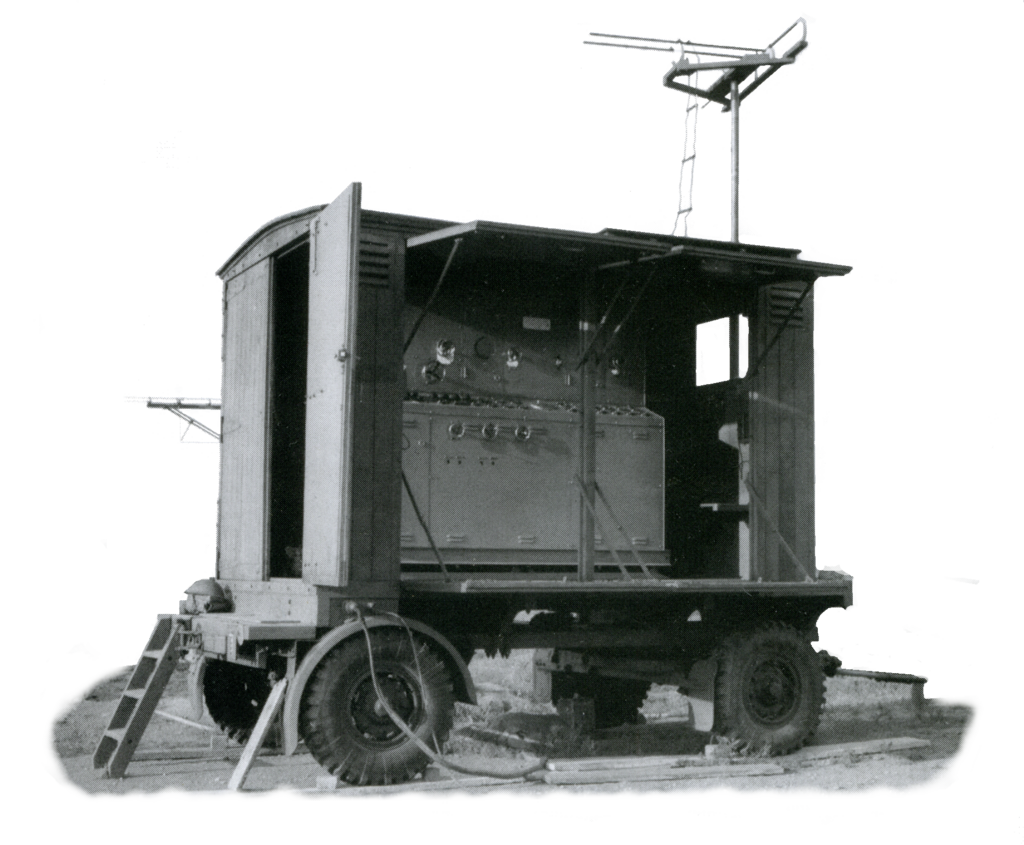
The first prototype of the Radar GL No.1 (Gun Laying Radar No. 1 Mk 1) was produced in 1937. By 1938 it had reached a stage of development to enable the demonstration of range accuracy. Spot bearings could be produced but it was not yet able to produce a continuous read out of bearing. Measurement of the angle of elevation was also problematic.
In early 1939 it was decided to produce a limited number of sets. These would give searchlights and predictors an early warning enabling them to lock on to visible targets. It also provided hands on training and experience for the operators and act as an early user trial.
Transmitter and Receiver were mounted in separate cabins on a 4 wheeled trailer and were sited about 90m (100 yards) apart. The transmitter cabin was fixed but the receiver needed to be rotated manually. This was done by means of hand operated pedals through a chain drive to the rotating gear. It was a very slow process with the cabin being traversed left and right until a target was found.
Accuracy was good being within 2 degrees for bearing and plus or minus 23m (25 yards) for range. The set could operate out to about 27 km (30,000 yards). Bearings could be produced approximately every 30 seconds. It entered service in August 1939 and 410 sets were produced.
A number of improvements were made in 1940 and the sets were upgraded to GL1* standard. At about the same time they were modified by having an elevation finding attachment fitted. Two half-wave dipoles were fitted, one above the other, on a mast on the receiver cabin. This became the GL1 E/F.
It required a uniform and consistent ground reflected signal to be combined with a signal direct from the target. To achieve this a uniform ground mat was laid around the radar. It consisted of an octagonal mat 120m (130 yards) in diameter and formed from metal stakes in the ground to a uniform height, joined by tensioned wires. Wire netting was then laid over this structure to form the mat and a wooden walkway built to reach the cabin. The whole thing took 50 men four weeks to lay.
| Frequency | 54.5 to 85.7 MHz |
| PRF | 1.5 kHz |
| Pulsewidth | 3 µs |
| Azimuth | ±20º from current bearing |
| Power | 50 kW peak |
Page last updated on 11/6/26.